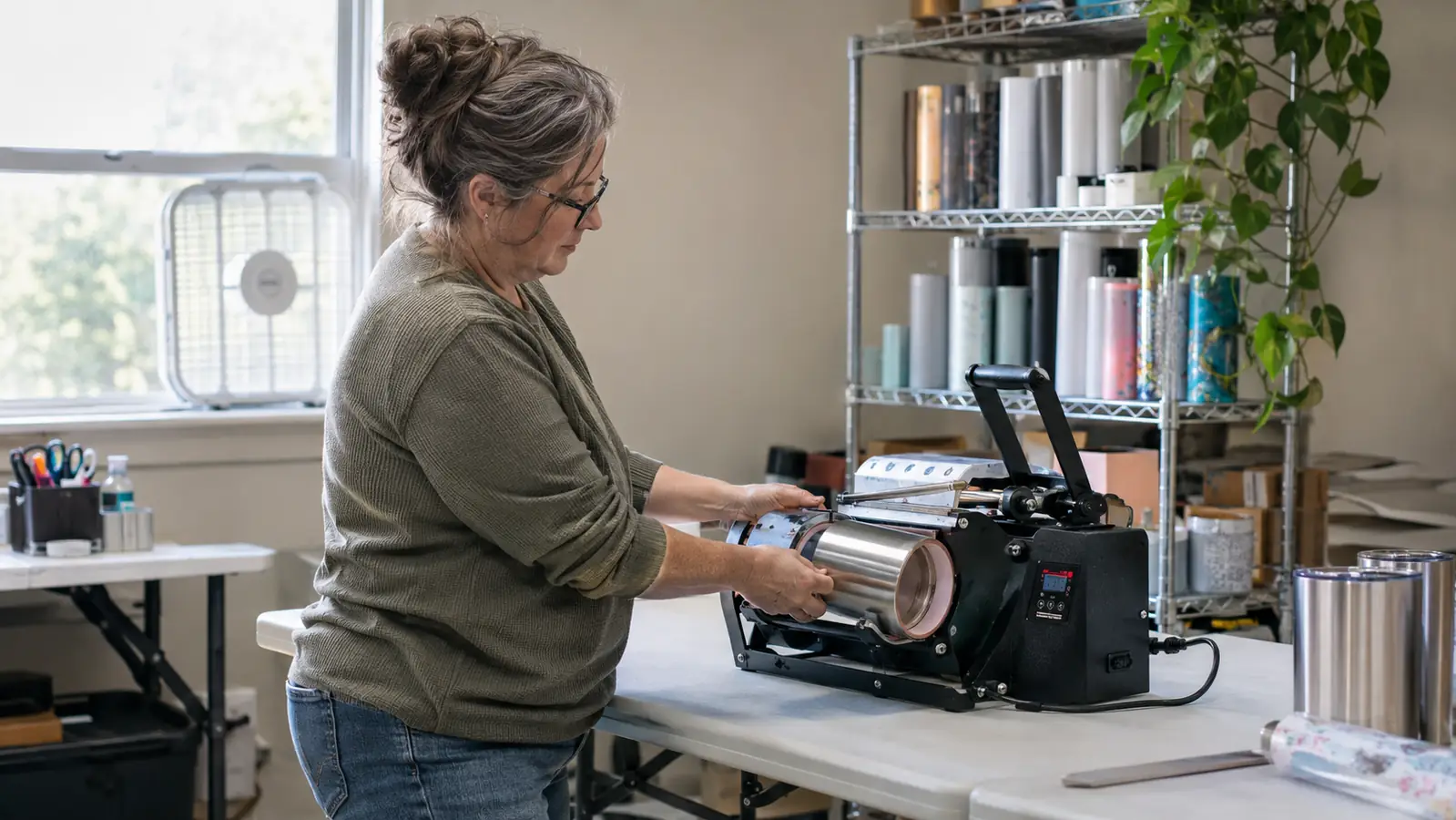
If you have ever wrapped a tumbler in shrink wrap, taped it into a tower of cardboard, and slid it into a cold oven hoping the design would not ghost, you already know why I bought the HTVRONT Auto Tumbler Press. I am Darla, I press shirts and tumblers out of my spare bedroom in Lincoln, and for the first year I did every tumbler the oven way. Then I spent a long weekend with this machine, and I have used it for every tumbler since. This is the long-term review I wished I had found before I bought it.
The short version: the HTVRONT Auto Tumbler Press is the tool that finally made sublimation on tumblers feel like a craft instead of a gamble. It is not the cheapest way to start, and it is not magic. It is a machine that does one thing, does it consistently, and has held up through about two years of weekly use in my craft room.
The Quick Verdict
If you sell or gift more than a few tumblers a month, the HTVRONT Auto Tumbler Press pays for itself in saved blanks, saved time, and saved sanity. It has limits, but for a home crafter it is the right tool.
Amazon Check Today's Price →Stop losing tumblers to the oven method
The HTVRONT Auto Tumbler Press rotates the tumbler, holds the temperature, and takes the guesswork out of sublimation. See today's price on Amazon and read what 2,400+ buyers say.
Amazon Check Today's Price on Amazon →How I've Used It
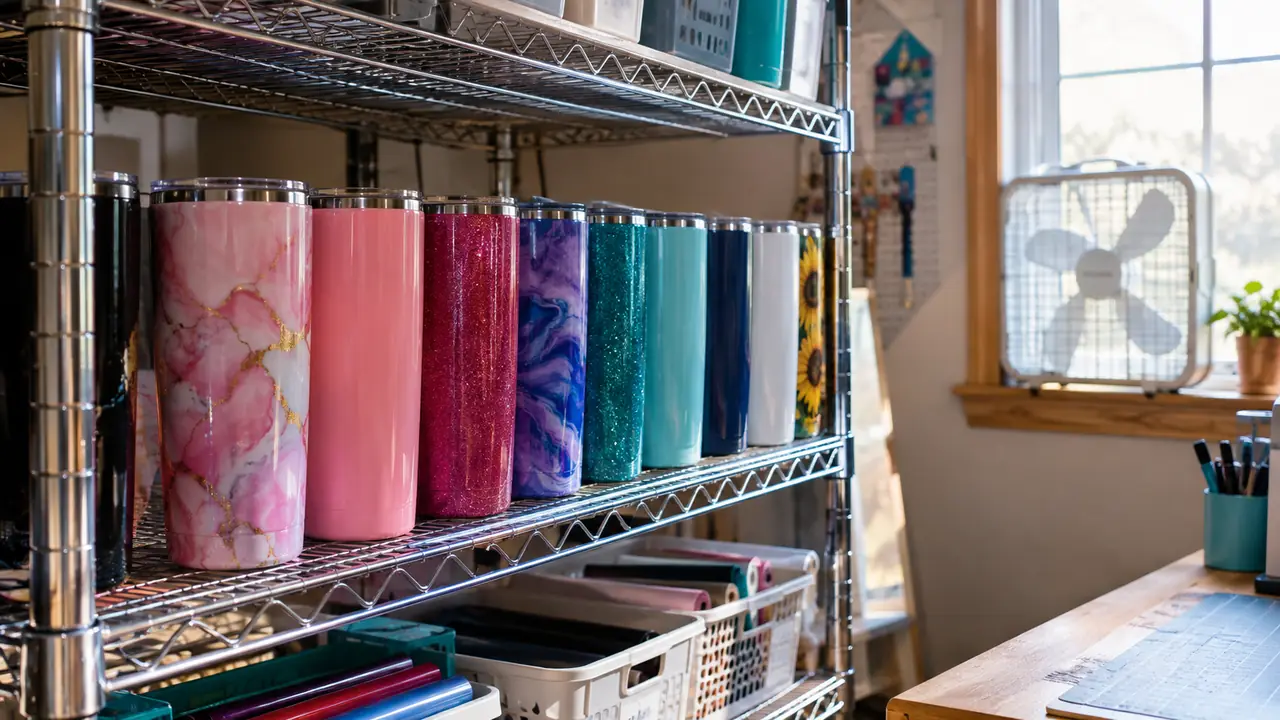
I have had the HTVRONT Auto Tumbler Press for about two years. In that time I have pressed somewhere around 140 tumblers: 20 oz skinny tumblers for a church women's retreat, 30 oz tumblers for a family reunion, a batch of 12 oz coffee cups for the school spirit table, and a steady trickle of one-off orders for birthdays and thank-you gifts. Most of my work is small orders, a few at a time, and that is exactly the pace this machine suits.
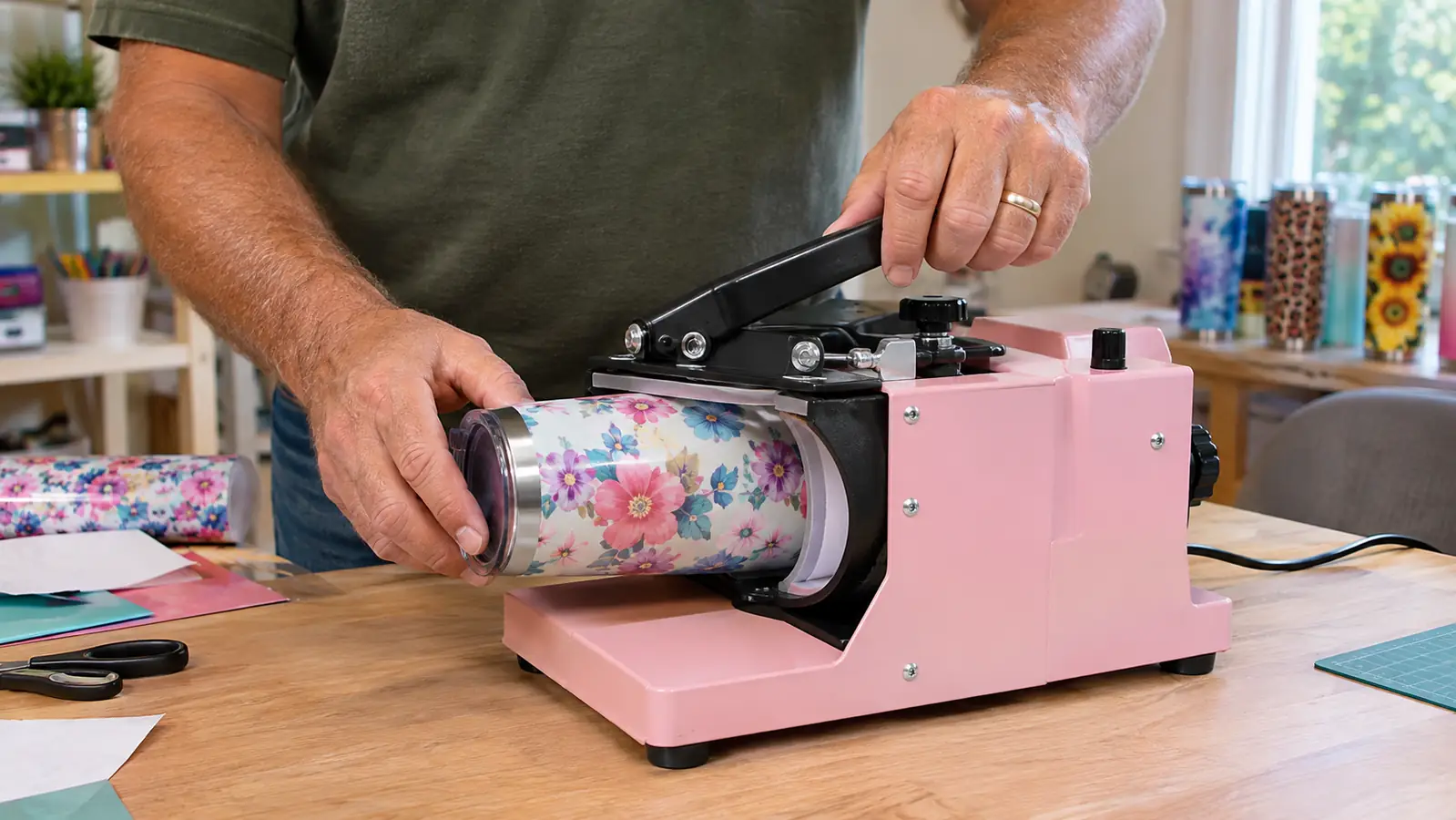
My routine has not changed much since the first week. I wrap the tumbler in sublimation paper, tape it snug, slide it over the silicone sleeve, and close the clamp. The press starts rotating on its own, and I set a timer on my phone. When the timer goes off, I open the clamp, pull the tumbler off, and let it cool on the table before I peel the paper. The whole thing takes about six minutes of hands-off time per tumbler, and I can use those minutes to prep the next wrap or start a shirt in my other press.
The biggest change is that I no longer dread tumblers. With the oven method I was always checking the temperature, turning the tray, and praying the wrap did not slip. With the HTVRONT press, I set it and walk away. The rotation is steady, the heat is even, and the results are consistent enough that I trust a batch of six to come out looking like a batch of six.
I bought the press on a Tuesday in late February, and it sat in the box for three days while I talked myself into setting it up. That Saturday I cleared the folding table, unpacked the machine, and pressed my first tumbler with a simple blue monogram. It came out fine, which surprised me. My second tumbler, a coral design with a sunflower, came out light in one stripe because I had not let the machine hold temperature long enough after warm-up. I wrote the settings down in a spiral notebook I keep on the wire shelf, and from tumbler number three on, the results have been steady.
The routine that works for me: 400 degrees, 180 seconds, paper wrapped tight enough that the edges stay put but not so tight the tape leaves a mark. I use a lint roller on the tumbler before I wrap it, because a single speck of dust under the paper shows up as a white dot on the finished design. That trick came from a failed batch of six 12 oz cups for the school spirit table in April. Every cup had a small white dot on the logo, and I could not figure out why until I pressed a bare tumbler and saw the dust on the sleeve.
What the HTVRONT Auto Tumbler Press Does Well
The first thing you notice is the auto rotation. The tumbler spins slowly and evenly the whole time it is heating, which is exactly what fixes the two most common sublimation failures: ghosting and patchy spots. When I wrapped tumblers for the oven, the paper could shift, the heat could hit one side harder, and I would open the oven to find a design that looked like it had been printed twice. The HTVRONT press rotates the tumbler through the heat the whole cycle, so the design bakes in evenly. I have not had a ghosted tumbler since I switched.
The second thing is temperature control. The press has a digital display and a timer, and it holds the temperature steady instead of drifting the way my kitchen oven did. I press most of my tumblers at 400 degrees for about 180 seconds, and the machine holds that setting from the first tumbler to the last. That consistency matters more than any other feature, because sublimation is picky. A few degrees off and the design comes out faded. A few seconds too long and the coating scorches. The HTVRONT press takes both of those variables off the table.
The third thing is the size range. The press handles the standard 20 oz and 30 oz skinny tumblers that most of my customers want, and it also fits 12 oz cans and smaller cups. I have pressed all three sizes without any special adapters. The silicone sleeve grips the tumbler firmly, and the clamp adjusts easily. If you mostly make the popular sizes, this machine covers them.
The auto rotation also means I can press a design that wraps all the way around, like the full-bleed sunflower pattern I made for the fall craft fair. With the oven, a wrap-around design was almost guaranteed to ghost where the paper overlapped. On the HTVRONT press, the overlap lands in the same place every time because the rotation speed is fixed, and I have not seen a seam line on a single tumbler. I pressed forty of those sunflowers for the fair, and I had to make twenty more before the weekend was over.
How It Holds Up Over Time
After about two years and roughly 140 tumblers, the HTVRONT Auto Tumbler Press still heats evenly and rotates smoothly. The silicone sleeve shows a little wear where the tumbler slides on and off, but it has not cracked or torn. The clamp still closes firmly, and the digital display is as easy to read as it was on day one. I have not had to replace any parts, and I have not had a single mechanical issue.
The one thing I have learned to do is let the machine cool down before I store it. The press gets hot, and if I close the clamp on an empty sleeve while it is still hot, the silicone can take a set. I now leave the clamp open and let it cool for a few minutes after a batch, and that has kept everything in good shape.
I also learned early on that the press needs a little patience during warm-up. It takes a few minutes to reach temperature, and the first tumbler of a batch always presses a touch cooler than the rest. I now let it sit at temperature for a couple of minutes before I load the first tumbler, and that fixed the slightly faded first print I kept seeing.
The only repair-adjacent moment came in July, when the power cord got caught under the edge of the folding table and the machine shut off mid-press. I unplugged it, checked the cord for damage, and it has been fine since. I also clean the silicone sleeve about once a month with a damp cloth, mostly to wipe off the faint brown residue that builds up from the sublimation paper. The display panel still reads clearly, and the rotation motor has not slowed or started to squeak. For a machine that runs for a couple of hours most weekends, that is better than I expected.
The heaviest use it has seen was the week before the craft fair in September, when I pressed twenty-two tumblers in two days. The machine ran for hours at a stretch, and it did not overheat or skip a rotation. I gave it a ten minute break between batches, which is probably why it stayed happy.
I have not had a ghosted tumbler since I switched to the HTVRONT press, and that alone was worth the price of the machine.
The Tradeoffs and Limits
The HTVRONT Auto Tumbler Press is not a one-size-fits-all machine. It handles the standard skinny tumbler sizes beautifully, but it will not press a wide 24 oz tumbler or a tall skinny 40 oz. If you sell a lot of those sizes, you would need a different press or a separate attachment. I mostly make 20 oz and 30 oz, so this has not been a problem for me, but it is worth knowing before you buy.
The other limit is the learning curve. The machine is easy to operate, but sublimation itself still takes practice. You need to wrap the paper tight, tape it well, and use the right time and temperature for your blanks. The HTVRONT press makes the process consistent, but it does not make it automatic. My first few tumblers on this machine were still a little light because I had not figured out the right settings for my blanks. Once I did, the results were reliable.
The press also takes up a fair amount of table space, and it is not quiet. The motor that rotates the tumbler makes a low hum the whole time it is running. It is not loud enough to be annoying, but it is noticeable in a small room. I keep mine on the folding table in my craft room, and the hum is just part of the background now.
One more thing to know: the press does not come with a way to hold a tumbler that is not perfectly straight-sided. I tried a tapered 24 oz tumbler with a wider base in June, and it wobbled on the sleeve badly enough that I stopped the press after twenty seconds and finished it in the oven. The machine is built for straight-sided skinny tumblers, and it is honest about that. The clamp also sits high, so I have to stand when I load and unload it. My craft table is about thirty inches tall, and after a long afternoon I started keeping a stool nearby.
What I Liked
- Auto rotation presses the whole design evenly, so ghosting and patchy spots basically stopped for me
- Holds temperature and time steady, which is what sublimation needs
- Fits 20 oz and 30 oz skinny tumblers plus 12 oz cups without any adapters
- Easy to learn in one weekend, even for a beginner with a home press
- Has held up through about 140 presses with no mechanical issues
Where It Falls Short
- Only fits straight-sided skinny sizes, not wide or 40 oz tumblers
- Needs a few minutes to warm up, and the first press of a batch runs cool
- Takes up real table space and hums the whole time it runs
- You still wrap the tumbler, set the timer, and peel the paper yourself
Who This Is For
The HTVRONT Auto Tumbler Press is for the home crafter who makes tumblers regularly enough that the oven method has become a chore. If you are pressing a few tumblers a month for gifts, or a batch for a church group or a family reunion, this machine will save you time and frustration. It is also for the crafter who wants consistent results without babysitting the process. The auto rotation and temperature control do the work, and you get your time back.
In my case, that is exactly the situation. I make most of my tumblers in batches of six to twelve, for the church craft table, Caleb's baseball team, and the fall fair. At that pace, the HTVRONT press has paid for itself in the time I am not standing over the oven, and in the blanks I am not throwing away.
Who Should Skip It
If you only make a tumbler once in a while, or if you are not sure you will stick with sublimation, the HTVRONT Auto Tumbler Press is probably more machine than you need. The oven method works fine for the occasional project, and the press is an investment. It is also not the right choice if you need to press wide or extra-tall tumblers, since this machine is built for the standard skinny sizes. And if you are looking for a completely hands-off process, remember that you still have to wrap the tumbler, set the timer, and peel the paper. The press makes the hard part easy, but it does not do the whole job for you.
Ready to retire the oven method?
The HTVRONT Auto Tumbler Press has been a steady workhorse in my craft room for about two years. Check today's price on Amazon and see if it is the right fit for your tumbler projects.
Amazon Check Today's Price on Amazon →