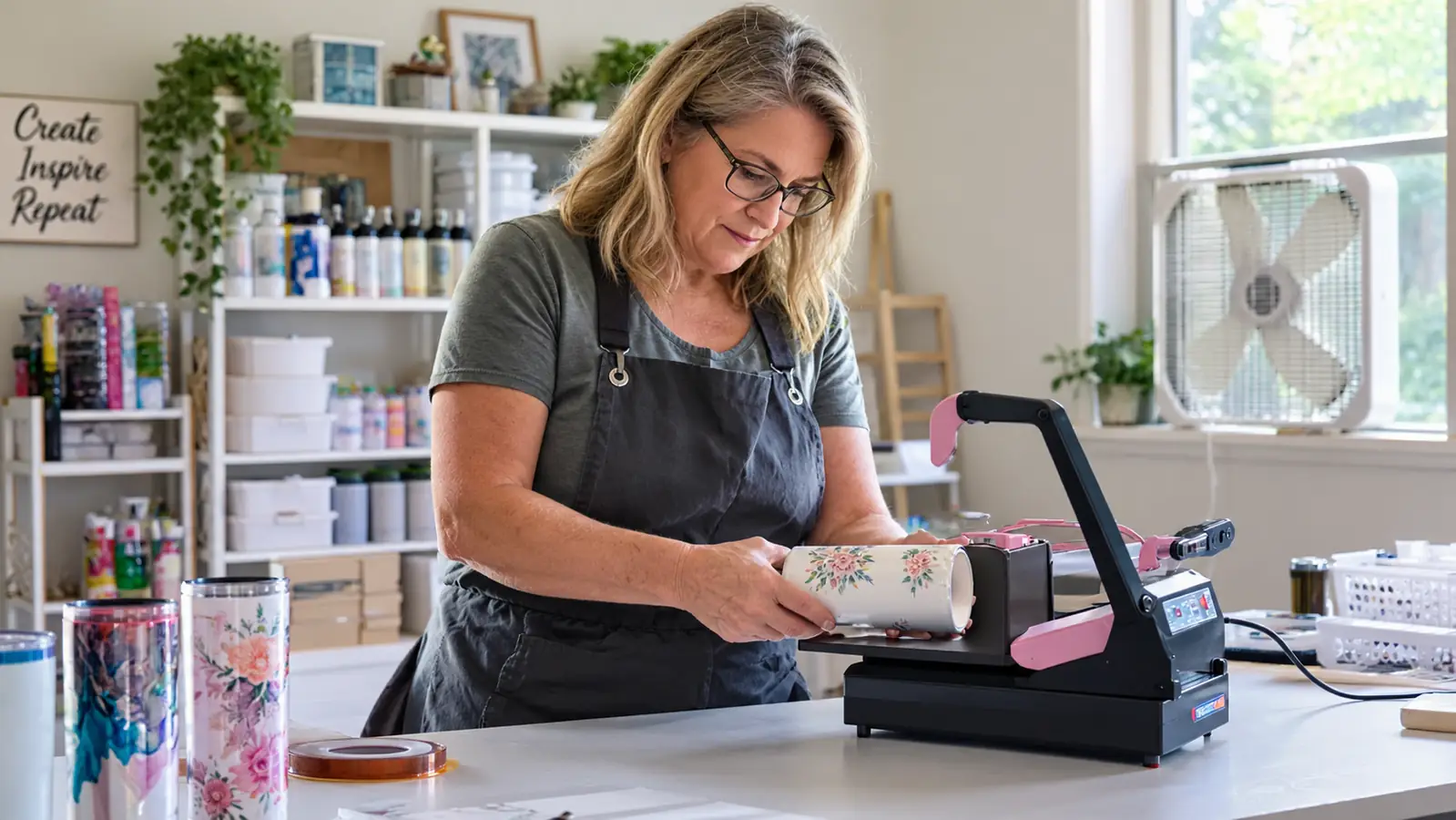
If you make sublimation tumblers at home, you have probably stood in your kitchen with a roll of butcher paper, a few rubber bands, and a convection oven that your husband Ron would rather you not use for craft projects. I did that for the first year of my side hustle, and I ruined enough blanks to buy a nice dinner for the whole church group. The batch that finally made me switch was six tumblers for the church rummage sale in October. I wrapped each one the way the tutorial said, tied them with cotton string, and set the oven to 400 degrees. Two came out with pale ghosted stripes where the paper had shifted, one was darker on one side from a hot spot, and the other three were fine. That is the oven method in a nutshell: three good ones, three ruined ones, and no way to predict which would be which. I still have one of those failed tumblers on a shelf in my craft room to remind me why I switched. Then I bought the HTVRONT Auto Tumbler Heat Press, and the way I work changed completely. This is the comparison I wish someone had given me before I started: the HTVRONT tumbler press versus the oven wrap method, plain and simple.
The short answer is that the HTVRONT press wins for anyone making more than a couple of tumblers a month, and the oven wins for exactly one situation: you already own a convection oven and you are only testing the waters. Everything else, the press saves you time, blanks, and a lot of burned fingers. I pressed my first one on a Tuesday afternoon in March, and by Friday I had made eight more. If you are reading this because you just ghosted your first tumbler, I want you to know it is not you. It is the method.
| HTVRONT Tumbler Press | Oven Wrap Method | |
|---|---|---|
| Setup | Plug in, set time and temperature, wait for it to heat | Preheat oven, cut butcher paper, wrap tumbler, tie with string or bands |
| Time per tumbler | About 3 minutes of pressing plus a short cool down | 10 to 15 minutes in the oven plus preheat and cool down |
| Temperature control | Digital readout, set it and it holds | Oven dials drift, hot spots vary by shelf |
| Consistency | Same result tumbler after tumbler | First batch might be great, second batch ghosts or washes out |
| Kitchen use | Stays in the craft room, no food smells | Ties up the oven and makes the kitchen smell like scorched paper |
| Learning curve | A few practice tumblers to find your time and temp | A few practice tumblers to learn your oven's hot spots |
| Cost to start | Cost of the press plus blanks and paper | Cost of blanks and paper if you already own an oven |
| Best for | Regular orders, craft fairs, anyone selling tumblers | One-off gifts and testing whether you like sublimation |
Where the HTVRONT Press Wins
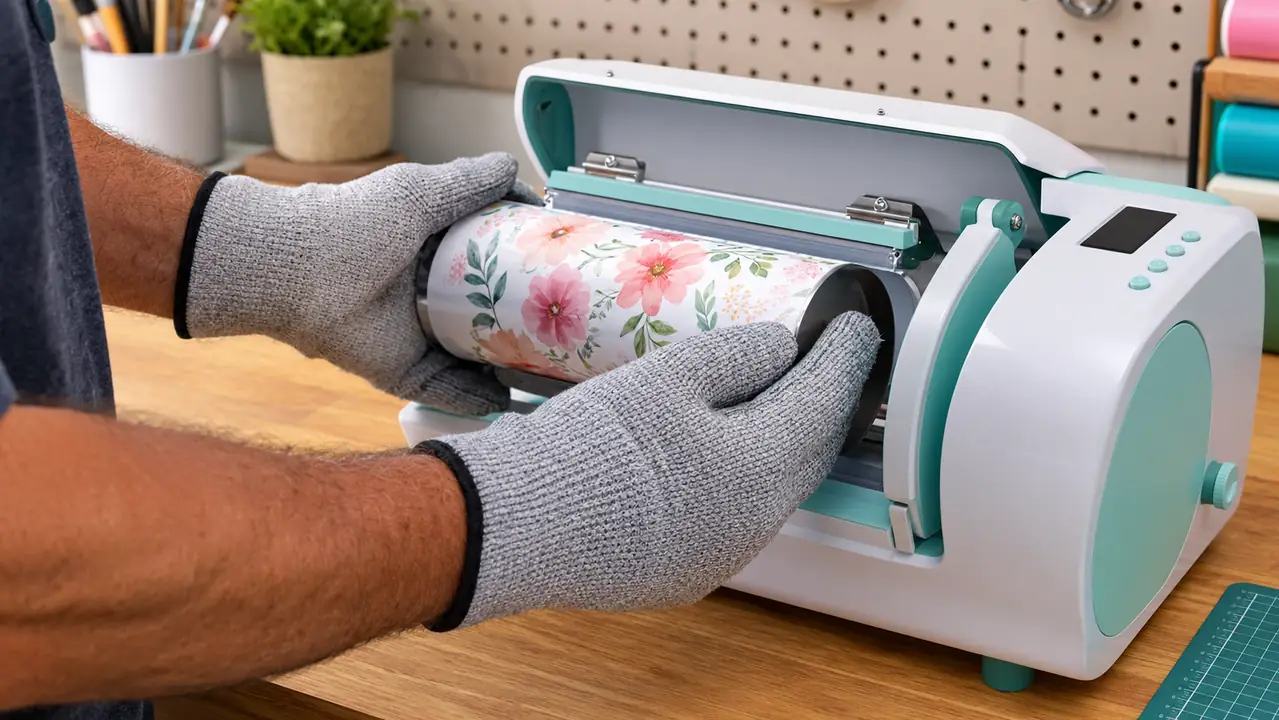
The biggest difference is consistency. With the oven wrap method, every tumbler was a small gamble. I would wrap the paper just right, tie it tight, set the oven to 400 degrees, and still get a tumbler that was washed out on one side or ghosted where the paper shifted. I kept a cardboard box under my craft table full of those failures, and every time I opened it I thought about the blank costs sitting in there. The HTVRONT press takes most of that guesswork away. The machine holds a steady temperature, the rollers turn the tumbler at an even speed, and the paper stays put because the press holds it against the blank the whole time. My first tumbler out of the press looked better than my best oven tumbler ever did. It was a plain white 20 ounce skinny tumbler for a church picnic, and the whole design came out even, edge to edge, with no pale stripe where the paper had lifted.
Time is the other big win. An oven batch takes 10 to 15 minutes of actual baking, plus preheat, plus wrapping, plus cooling before you can unwrap. I can press a tumbler in about two minutes with the HTVRONT, let it cool for a minute, and start the next one. The first real order I filled with the press was twelve tumblers for Caleb's baseball team. I set up in the craft room at nine in the morning, pressed all twelve before noon, and still had time to eat lunch before Ron helped me load the car. With the oven, the same order meant three batches, each one wrapped, baked, cooled, unwrapped, and checked, and I would usually lose at least one to ghosting. When I had to fill an order of twelve tumblers for a family reunion, the press turned what used to be a whole afternoon into a couple of hours. That matters when you are doing this in a spare bedroom between other parts of your life.
The waiting is what really adds up with the oven. Every batch meant preheating, then checking the shrink wrap was snug, then standing in the kitchen with a timer so a tumbler did not sit a minute too long. With the press I load the tumbler, close the lid, and go weed the next design while it runs. For a dozen tumblers for a family reunion, that difference was the better part of an evening given back to me, and nobody had to eat supper around a sheet pan of hot steel cups.
One thing I did not expect was how easy it is to switch between tumbler sizes. For a 20 ounce skinny tumbler I set the HTVRONT to 400 degrees for 180 seconds. For a 16 ounce straight wall tumbler I use 400 degrees for 160 seconds. The press has a digital screen, so I just punch in the numbers and it remembers the last setting. With the oven, every size meant a new guess about where to put the tumbler on the rack and how long to leave it. Now I write the settings on a sticky note and tape it to the side of the machine.
The first craft fair I brought press-made tumblers to was in November. I set up a card table next to Ron, who handled the cash box, and I sold eleven tumblers before lunch. With the oven method, that many tumblers meant three batches of baking and at least two ruined blanks. With the press, I had pressed them all the weekend before and they were stacked in a box, ready to go.
Where the Oven Wrap Method Wins
I am not going to pretend the oven never has a place. It is how I started, and it is how a lot of people start, because it costs nothing extra. Ron put up with the smell for a while, but he drew the line after I pressed a batch of peach-scented tumblers and the whole kitchen smelled like a bakery for two days. I also learned the hard way that our oven has hot spots. The back right corner runs about 25 degrees hot, and I only figured that out after three tumblers came out noticeably darker on one side. If you are brand new and not sure sublimation is for you, the oven wrap method lets you try it with almost no new equipment. You need blanks, sublimation paper, butcher paper, and something to tie the wrap. Most people already have an oven. That is a real advantage when you are just testing whether you like this craft, and it is the honest reason I tell curious friends to start there if they are not ready to buy a press.
The oven also wins on space. My HTVRONT press lives on the folding table in my spare bedroom, and it takes up a solid chunk of that table. The table is six feet long, and when the press is out I have to shuffle my paper cutter and blank stack around to make room. In the oven days, the only thing that took up space was a roll of butcher paper in the pantry. If you are working in a tiny apartment or you only make a tumbler once a year for a gift, a machine that sits on your counter is a lot to store. The oven method uses nothing you do not already have. For a once-a-year hobby, that is a fair trade. For anyone making tumblers on a regular basis, the trade stops being worth it pretty fast.
I will also give the oven credit for teaching me how wrapping works. Before I understood why paper had to be tight, I blamed the blanks. Then I spent an afternoon pressing the same design onto three tumblers, one wrapped in butcher paper, one in parchment, and one in the same paper but tied tighter. The tighter one came out best. That lesson carried over to the HTVRONT, where the press does the holding for you. So the oven was a useful teacher. I just would not want to keep taking its classes.
The oven also wins if you are making something that is not a tumbler. A press is built for round blanks. The oven can handle a flat slate tile or a mousepad if you wrap it right. I have not used mine for that in a while, but it is nice to know the option is there.
Stop babysitting the oven and start pressing tumblers that come out right the first time
The HTVRONT Auto Tumbler Heat Press holds its temperature, turns the tumbler evenly, and takes the guesswork out of sublimation. It is the reason my craft room smells like a workshop instead of a kitchen.
Amazon Check Today's Price on Amazon →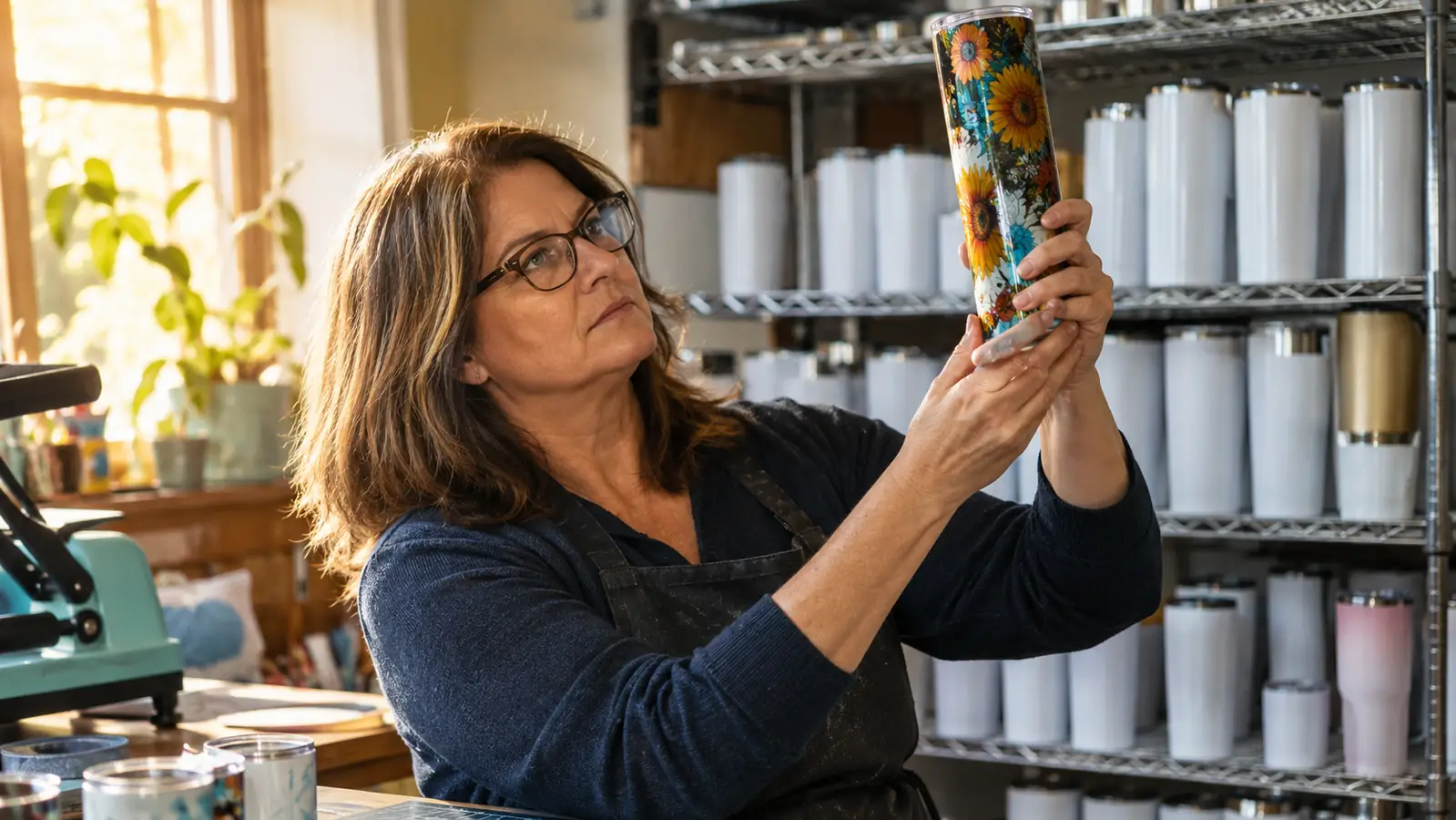
Who Should Buy Which
Buy the HTVRONT press if you are making tumblers for more than just yourself. If you have taken an order, or you want to take orders, or you are tired of throwing away blanks that ghosted in the oven, the press pays for itself in saved blanks and saved time. I bought mine about two years ago, and the first thing I did was press a test tumbler with the same paper and blank I had been using in the oven. The difference was so obvious that I packed up the butcher paper and rubber bands and put them in the donation box. It paid for itself in saved blanks within the first few craft fair seasons, and I stopped apologizing to Ron for the kitchen smelling like burnt paper.
Stick with the oven wrap method if you are genuinely just trying sublimation for the first time and you are not sure you will keep doing it. Make a few tumblers, see if you enjoy it, and if you do, then look at a press. The HTVRONT is the natural next step, and it will make everything you learned in the oven easier. But you do not need to buy a machine to find out whether you like the craft.
Here is the test I use when someone asks me whether they should buy a press. If you have a list of people waiting for tumblers, or if you already know the design you would make for the fall craft fair, buy the press. If you are just curious about sublimation and you have a free afternoon, use the oven. The HTVRONT will still be there when you are ready, and you will appreciate it more after you have fought with a few oven batches.
One more thing: if you buy the press, give yourself a weekend to learn it. The first time I used mine I set the temperature wrong and got a washed out design, but it took one try to fix, not a whole batch. That alone is worth the switch.
My first tumbler out of the HTVRONT press looked better than my best oven tumbler ever did, and it took about two minutes instead of twenty.
If you are done gambling on oven hot spots, this is the press to start with
The HTVRONT Auto Tumbler Heat Press is the machine I reach for every single time now. It is easy to learn, consistent, and it stays in the craft room where it belongs.
Amazon Check Today's Price on Amazon →